


I recently came across a book titled The Watchtower and the Masons by Fritz Springmeier which contains an investigation into the “great work” of Charles Taze Russell and his founding of the early Jehovah’s Witness cult known as the Watchtower Society. I briefly covered Russell and his contributions to the creation of the Zionist state in my recent 2 part series on esoteric Protestantism. However, after coming across Springmeier’s excellent research, I found that Russell is even more of a key figure than I had presented in my work.

In North America, millenarian sects spread throughout the northeast with the emergence of the Milliterite cult led by William Miller, a Freemason who began sharing his false predictions of an imminent second coming of Christ between 1843 and 1844.
When Miller’s prophecies failed, the Millerites dispersed and formed various millenarian sects, mainly as the Adventists. After becoming disillusioned with the hellfire and brimstone teachings of his Presbyterian upbringing, Charles Taze Russell, an Adventist minister under the discipleship of Miller, sought to reinterpret the Christian faith completely with an Arian and masonic synthesis which he spread through Bible studies and pamphlets called Zion’s Watchtower. Springmeier documents how The Watchtower Society’s top financial supporter was B’nai Brith, which later became the Anti-Defamation League.
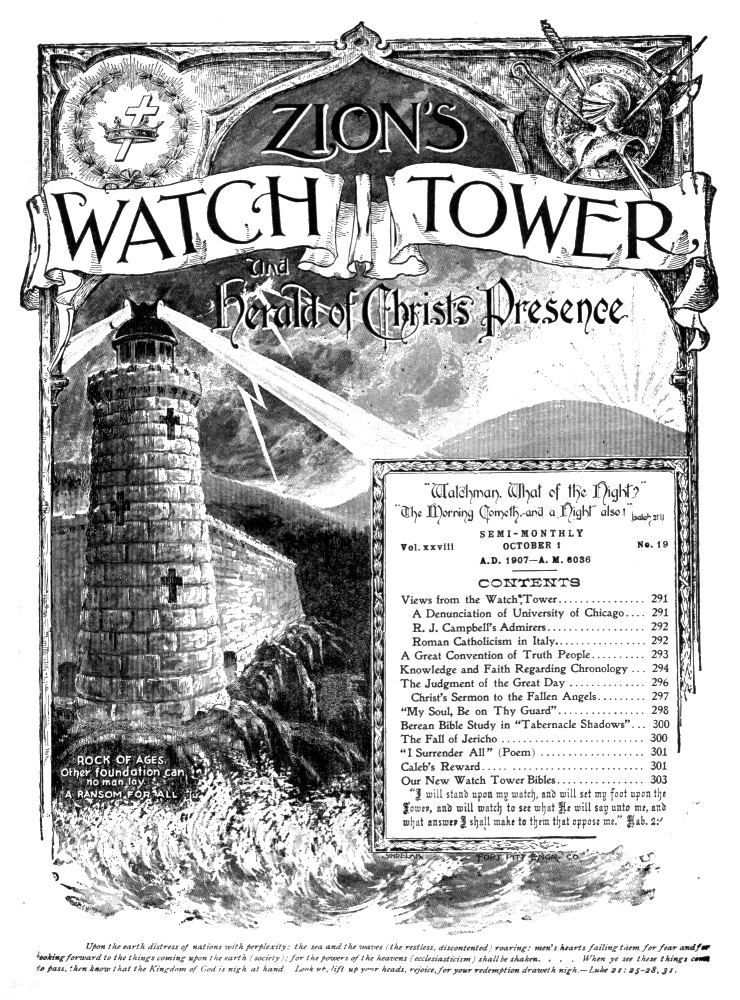
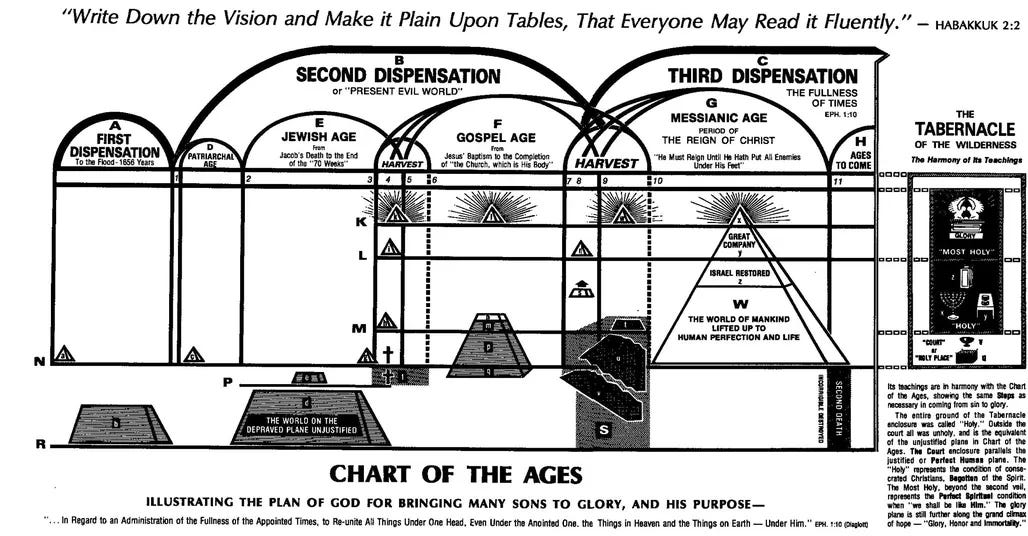
By 1879, Russell became the most prominent Christian Zionist of his time, teaching that “God's favor had been restored to Jews as the result of a prophetic "double" which had ended in 1878 and was also reported to have worked with the Rothschilds in the Zionist project.
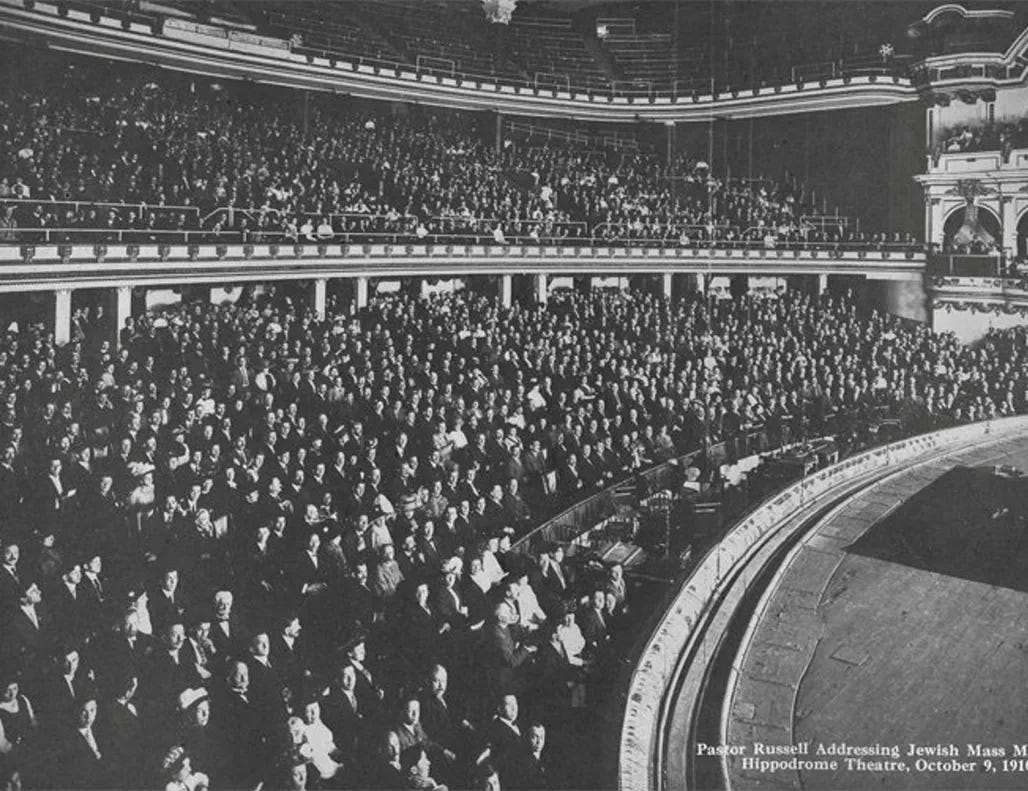
In 1910, Russell’s Zionist propaganda became the most widely distributed, privately published literature in the United States. In his rise to fame, Russell conducted a mass meeting at the Hippodrome, New York’s largest theater at the time, where he delivered a sermon titled Zionism in Prophecy on how God had a separate covenant with the Jews apart from the Christians; thus Jewish conversion to Christianity was not necessary in their divine calling back to rule as the center of God's Kingdom in Palestine. The New York American reported on that day:
The unusual spectacle of 4,000 Jews enthusiastically applauding a Gentile preacher, after having listened to a sermon he addressed to them concerning their own religion. The mention of the name of a great leader [Herzl] who, the speaker declared, had been raised by God for the cause—brought a burst of applause.
Russell's legacy as an enthusiastic, non-proselytizing Zionist has been acknowledged by none other than the incumbent prime minister of Israel, Benjamin Netanyahu, who said, “A recognition of Pastor Russell's important role as an early American Christian advocate of Zionism is long overdue.” The late Jeane Kirkpatrick, former the U.S. ambassador to the UN, called Russell a “neglected man and chapter in the history of Zionism.”1
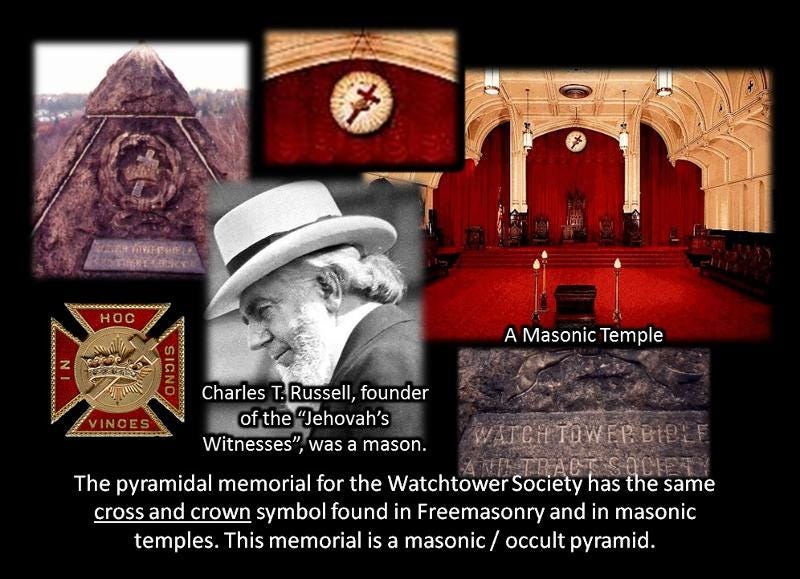
Although there is some debate over Russell’s involvement with Freemasonry, Springmeier provides overwhelming evidence throughout his 200 page book. It includes a thorough comparison of the symbolism and teachings Russell adopted from Scottish Rite Freemasonry with Jehovah’s Witness doctrine. Among the most prominent symbols were the Knight’s Templar Cross and Crown which appeared as a 25 foot backdrop behind Russell during his famous Hippodrome speech.
This emblem seemed to go everywhere Russell did. It was placed on Convention souvenirs, on napkins at conventions, on the various periodicals Russell published, and on his stationery.
Russell was also obsessed with pyramids which was prominent throughout his work and even in his death as he was memorialized in a large pink granite pyramid grave with a Cross and Crown symbol on the capstone.
In fact, one of the more bizarre stories is of Russell’s death which occurred on Halloween night in 1916 while wearing a Roman toga at his request. Some accounts claim was a ritual murder followed by a Rosicrucian ceremony.
When they built the pyramid at his grave they incased within the granite a sealed box containing a set of Studies in the Scriptures, copies of Russell's tracts, pictures of him, a complete set of Karatol Scripture Studies, and many other things to prepare him for the people he would met in the next life.2
More of Springmeier’s research is examined in my livestream above, which has quickly become my most viewed video on YouTube. Subscribe to my channel for more weekly deep dives on the research I do for my work here on Substack. Hope to see you in an upcoming stream!
Phillipe, Bohstrom. “Before Herzl, There Was Pastor Russell: A Neglected Chapter of Zionism” Haaretz, May 2023, archive.is/5y4Hu#selection-2437.0-2437.219.
Souvenir Report of the Bible Student's Convention (Pittsburg, PA) Jan. 2-5, 1919


